Market size and growth trajectory
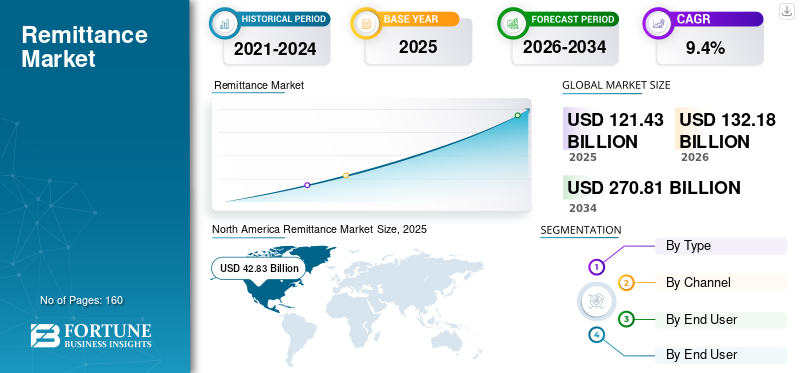
The global remittance landscape is massive and still expanding. According to the Migration Policy Portal, international money transfers reached $905 billion in 2024, marking a 4.6% increase from the previous year[1]. This steady growth highlights the enduring demand for cross-border payments, driven largely by migrant workers supporting families in emerging economies.
While traditional corridors dominate the current volume, a new segment is gaining structural momentum. The crypto-powered remittances market is projected to grow from $34.96 billion in 2026 to $85.77 billion by 2030, reflecting a compound annual growth rate (CAGR) of 25.2%[2]. This rapid expansion suggests that crypto is moving from a speculative alternative to a core infrastructure layer for global value transfer.
For a 2026 global crypto remittance analysis, understanding this divergence is critical. Traditional channels provide stability and scale, but crypto offers the speed and cost efficiency that legacy banks struggle to match. As regulatory frameworks mature, the gap between these two models is likely to narrow, creating a hybrid ecosystem where both play distinct but complementary roles.
How blockchain infrastructure is fixing remittance inefficiencies
Traditional banking rails are built for a world that no longer exists. When you send money across borders using legacy systems, you are essentially paying for the inefficiencies of intermediaries. Banks, clearinghouses, and correspondent networks all take a slice, and the settlement times drag on for days. This friction is exactly why global crypto remittance analysis points toward blockchain infrastructure as the primary solution for speed and cost reduction.
Stablecoins have emerged as the practical bridge between traditional finance and decentralized networks. Unlike volatile cryptocurrencies, stablecoins pegged to fiat currencies offer the speed of blockchain without the price swings. This stability allows migrant workers to send money home knowing the value won’t erode before the recipient receives it. Research indicates that integrating blockchain technology into these flows can significantly reduce the cost of transactions, often cutting fees by more than half compared to traditional wire services.
The efficiency gains aren't just about lower fees; they are about transparency and speed. Blockchain networks settle transactions in minutes, not days. This immediacy provides critical liquidity to families who rely on these funds for daily needs. By bypassing the traditional correspondent banking system, stablecoins remove the need for pre-funded nostro accounts, which tie up capital and add hidden costs. The result is a remittance infrastructure that is faster, cheaper, and more accessible to the unbanked.
Regional adoption and key markets
Use this section to make the Global Crypto Remittance Analysis decision easier to compare in real life, not just on paper. Start with the reader's actual constraint, then separate must-have requirements from details that are merely nice to have. A practical choice should survive normal use, maintenance, timing, and budget. If a recommendation only works in an ideal situation, call that out plainly and give the reader a fallback path.
The simplest way to use this section is to write down the must-have criteria first, then compare each option against those criteria before weighing nice-to-have features.
Strategic considerations for users
Use this section to make the Global Crypto Remittance Analysis decision easier to compare in real life, not just on paper. Start with the reader's actual constraint, then separate must-have requirements from details that are merely nice to have. A practical choice should survive normal use, maintenance, timing, and budget. If a recommendation only works in an ideal situation, call that out plainly and give the reader a fallback path.
-
Verify the basicsConfirm the core specs, condition, and fit before comparing extras.
-
Price the downsideLook for the repair, maintenance, or replacement cost that would change the decision.
-
Compare alternativesCheck at least two comparable options before treating one listing as the benchmark.
Frequently asked questions about global crypto remittance analysis
Who are the top 5 recipients of remittances? India remains the largest recipient, followed by China, Mexico, the Philippines, and Egypt. These nations collectively receive a significant portion of the estimated $905 billion in global remittance flows in 2024, with crypto adoption growing rapidly in countries like Mexico and the Philippines.
Can the IRS see your crypto wallet? Yes. The IRS receives transaction data from most major exchanges via Form 1099-K and 1099-B. Even self-custodied wallets are reportable if they interact with regulated on-ramps or off-ramps. The agency increasingly uses blockchain analytics to trace flows for tax compliance.
Which country is number one in cryptocurrency? El Salvador holds the title of the first nation to adopt Bitcoin as legal tender, making it a unique case in global crypto remittance analysis. However, in terms of adoption and usage volume for remittances, countries like Venezuela and Argentina show higher relative engagement due to local economic pressures.
What is the 51% rule in crypto? Often referred to as a 51% attack, this occurs when a single entity controls more than half of a blockchain’s mining hash rate. This control could theoretically allow them to reverse transactions or double-spend coins, though it is extremely difficult and costly to execute on major networks like Bitcoin or Ethereum.
No comments yet. Be the first to share your thoughts!